
 When we think of a human’s basic needs—what a person needs to survive—we often think of water, food, and shelter. Give me something to drink and eat and a roof, and I can live indefinitely, right? Well, not really. It turns out that another basic human need is love. We need to be loved to live.
Our Need of Love
Depending on how you feel about psychological studies, you can research this if you’d like and find some interesting (as well as some quite twisted) studies done in the past to prove our need of love. But you don’t have to go any further than the Bible. At the end of 1 John 4:8, we read point blank that “God is love.” And we know we are created to need God, so theologically, it makes sense that we need love—both the love of our Creator and the love of others, as He designed us to be in community as He is in community within His divine triune nature (the Father, Son, and Spirit eternally and perfectly loving one another).Don’t Miss Leah
This can be a little bit of a challenging session, because there is so much ground to cover, and the tendency is to focus on Jacob and Rachel. That’s understandable—after all, it is what we have titled the session! Of course, Jacob is our focus as the son of promise and most of the narrative centers on his relationship with Rachel. So we need to spend time there, of course, but I want to encourage you to try to guard some time to get to Leah. if you read through these chapters too quickly, she almost feels like an afterthought—a parenthetical inclusion in Jacob and Rachel’s story. But we have so much to learn from this unloved woman.When Love Is Absent
Jacob the swindler had been swindled. The man who had deceived his own father had been deceived—bettered—by his uncle. The morning after his marriage, Jacob woke up not to find his beloved Rachel next to him, but her sister Leah. Laban had tricked him and because of that, Jacob would need to work another seven years—fourteen in total—to marry the woman he loved. The Scriptures do not tell us, but one can imagine that Jacob did not get over this quickly—his lack of love of Leah seemed to bear witness to the likelihood of such a grudge. While Genesis 29:30 tells us that Jacob loved Rachel more than Leah, when we read the next verses, we see that whatever love Jacob had for Leah was insufficient. In fact, God saw a woman who was unloved (v. 31). In the Hebrew, this term literally means “hated.” Here was Leah, the wife of a man who did not love her, a woman who knew that her husband had not chosen her. Don’t miss the deep pain in this woman’s heart. She was a broken woman. A desperate woman. A woman who was in dire need to be loved.A Failed Attempt to Earn Love
When Leah gave birth to a son she named him Reuben, which means “see a son!” and is a pun on “has seen.” [1] Moses, the writer of Genesis, explains the wordplay involved with this name: Leah saw her son as evidence that God was aware of her affliction—her loveless condition in her marriage. And her hope was that this son would prompt Jacob to love her. She would be disappointed. She would remain unloved. In time, Leah gave birth to a second son and named him Simeon, which is a word play of “heard.” Again, Leah believed that this son was evidence that God had heard her affliction—that she was unloved—and provided a son to draw Jacob to her. Once again, she would be disappointed. She would remain unloved. In time, Leah gave birth to a third son and named him Levi, which is a wordplay of “become attached to.” Notice that this birth seems to be her last attempt at earning her husband’s love. “At last,” she says. At last this third son—an overwhelming blessing from the Lord—would earn her husband’s love and “attach” them together. But once again she would be disappointed. She would remain unloved.The Gift of Love
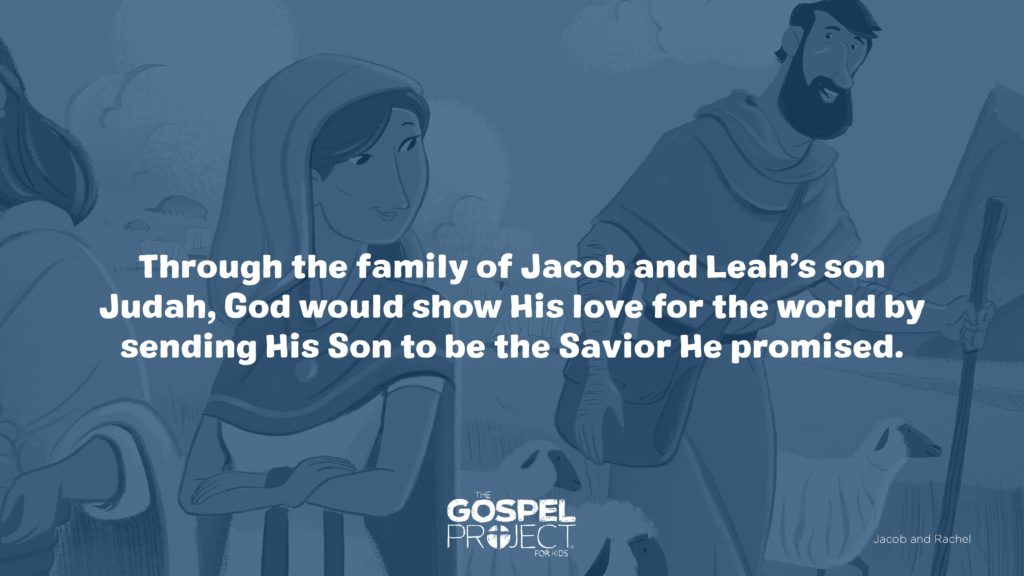
After three failed attempts to earn the love of her husband, Leah threw in the towel. She gave up. But somehow—and I really wish the Bible shared details of this—Leah came to a greater understanding. Notice the shift in her disposition between verses 34 and 35. When she gave birth to a fourth son, she named him Judah, which means “I will praise.” Leah was a woman who had given up on her husband’s love, but in doing so realized the greater love of her Father. God had given her four sons not to draw her husband closer to her, but rather to draw her closer to her God. Each child was God declaring, “I know that you are unloved by Jacob, Leah. I know that! But I love you. Jacob did not choose you, but I have chosen you. You are mine and you are loved completely! You don’t need to earn my love, you cannot earn what has already been given.” This is why you want to try to get to Leah in this session. Because it is through Leah that we see the gift of love—not Rachel for Jacob, although that was a good gift by God. And not even God’s love for Leah, as beautiful as that is. But rather, we see God’s love for us. Because God speaks the same truth over us. We are loved. We are chosen. We are His and we are loved completely. We don’t need to do anything to earn God’s love, because we cannot earn what has already been given.The only ground of God’s love is his grace. The ground of God’s love is only and wholly in himself. There is neither portion nor proportion in us to draw his love. There is no love nor loveliness in us that should cause a beam of his love to shine upon us.”—Thomas Brooks (1608-1680) [2]Preschool Tip: This week, make sure that you clearly, emphatically, and joyfully affirm God’s love for your preschoolers. But it also wouldn’t be a bad idea to affirm your love for them as well! Make it your goal that each preschooler leaves the time with you without any doubt that he or she is loved. Kids Tip: For those of us who teach kids, especially older kids, this session gives us a great opportunity to not only affirm God’s love for them, but also that God knows how they feel, and that He cares. Many of our kids are starting to experience emotions they may not have before—including perhaps loneliness and feeling unloved. And most of our kids probably aren’t at a place where they know how to talk about what they are feeling—so they keep it all bottled up. Leah affords us a great example of how God knows how we are feeling and that He cares. Our kids may feel alone, but they never are. They may feel unloved, but they never are. God is always there, loving them no matter what. [1] Explanations of Leah’s sons’ names come from Kenneth Matthews, The New American Commentary: Genesis 11:27–50:26, (Nashville: Broadman & Holman: 1996), accessed in mywsb.com. [2] Thomas Brooks, Heaven on Earth (CreateSpace Publishing Platform, 2014), 64. https://vimeo.com/279048775

Thank you Brian, for your insights! That was beautiful how Judah means “I will praise”. In the midst of my struggles, disappointments, failures, and heartaches, I choose to praise my God and my Redeemer, Jesus.
I am so excited about the Gospel Project! I find myself praising God during my own study and review of these lessons and it really helps me to better communicate the lesson to my small group of first graders. And I love the short video blogs by Jeremy! Thank you so much Brian and Jeremy! God bless you!